
- Introduction to Knowledge Graphs
- Understanding Knowledge Graphs
- Real – World Examples of Knowledge Graphs
- Knowledge Graphs- How It Works
- Why are Knowledge Graphs Important For AI?
- Ontology, Knowledge Base, And Knowledge Graphs
- Knowledge Graphs - The Foundation For Advanced AI Reasoning
- Knowledge Graphs- A Connected Backbone
KNOWLEDGE GRAPHS
The hidden map behind everything you search, see, and know.
Summary: Knowledge graphs are the intelligent connective tissues transforming raw corporate data into context-rich knowledge that LLMs can easily interpret. By mapping relationships and meaning, they empower companies to quickly surface relevant information and boost both the speed and accuracy of AI-driven insights.
The real challenge today isn’t data—it’s making AI understand context and nuance. And this shift – from raw processing to intelligent, context-driven insight hinges on a single, often overlooked powerhouse: the Knowledge Graph.
Understanding Knowledge Graphs
Ever wondered how everything just ‘Clicks’ online?
A Knowledge Graph is a structured base or network of interconnected entities—people, places, and things—that captures relationships and context, enabling machines to understand and analyze complex information meaningfully.
Components of a Knowledge Graph
Knowledge Graph uses a graph-structured model to represent and operate on data and consists of:
Nodes or Entities
The things– customers, products, concepts, or events.
Think of them as three dots. Say, a person named John, a place called Central Park, and a concept like friendship.
Edge(s) or Relationships
Connections between entities- like purchased, located in, or depends on.
It defines the relationships between nodes and illustrates how entities are connected.
Think of them as the lines connecting the dots, showing relationships: John lives near Central Park, or John is a friend of Jacob.
Attributes
Properties about entities and relationships.
Nodes and edges can have attributes that provide additional details about the entities or relationships.
Think of them as details added to the dots or lines—John’s node might include his age or job, and the edge showing lives near might specify the distance between John’s home and Central Park.
Ontology or Schema
A framework that defines the types of nodes and relationships that exist.
Graph Database Engine
The system that efficiently stores and queries the graph.
Collectively, these components support reasoning, inference, and dynamic exploration of the data.
Real – World Examples Of Knowledge Graphs
Amazon's Product Knowledge Graph
This graph links products, customer reviews, and buying behaviors. It allows Amazon to recommend products tailored to individual preferences, improving the overall shopping experience.
A Search Query
Let’s say, you search for “Pablo Picasso” – It doesn’t just show web links; it displays a summary with key facts, images, and related topics to give you a clearer, more helpful answer. This knowledge graph helps Google understand the relationships between different entities to provide more precise search results.
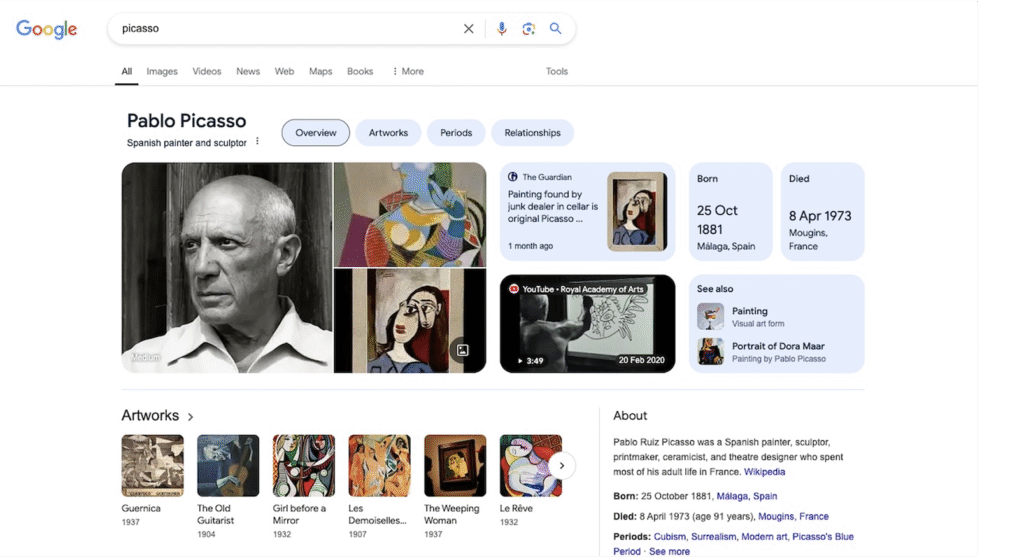
Image Source hikeseo.co
Consumer -Facing Knowledge Graphs
These are popular knowledge graphs that define user expectations for search systems in various organizations to improve search, recommendation systems, social networking, geographic information, and language understanding. They include-
Google Knowledge Graph
Enhances search results by organizing information about people, places, businesses, and things, drawing from sources like Wikipedia and Freebase.
Facebook’s Social Graph
Maps relationships and interactions among users to personalize content and ads.
Netflix Content Recommendation Engine
Uses knowledge graphs to deliver highly personalized show recommendations based on nuanced user preferences.
Amazon Product Knowledge Graph
Connects products, reviews, and purchasing behavior to offer personalized product recommendations and improve search.
LinkedIn Economic Graph
Maps relationships between people, jobs, companies, and skills to facilitate job matching, networking, and industry insights.
Wikidata
An open, multilingual knowledge graph collaboratively edited to provide structured data for various applications.
DBpedia
Extracts structured knowledge from Wikipedia infoboxes and links to fuel research and application development.
GeoNames
Provides geographical place names and spatial data useful for travelers and geographic applications.
WordNet
A lexical knowledge graph offering definitions and semantic relationships between words, enhancing NLP and language learning tools.
Knowledge Graphs- How It Works
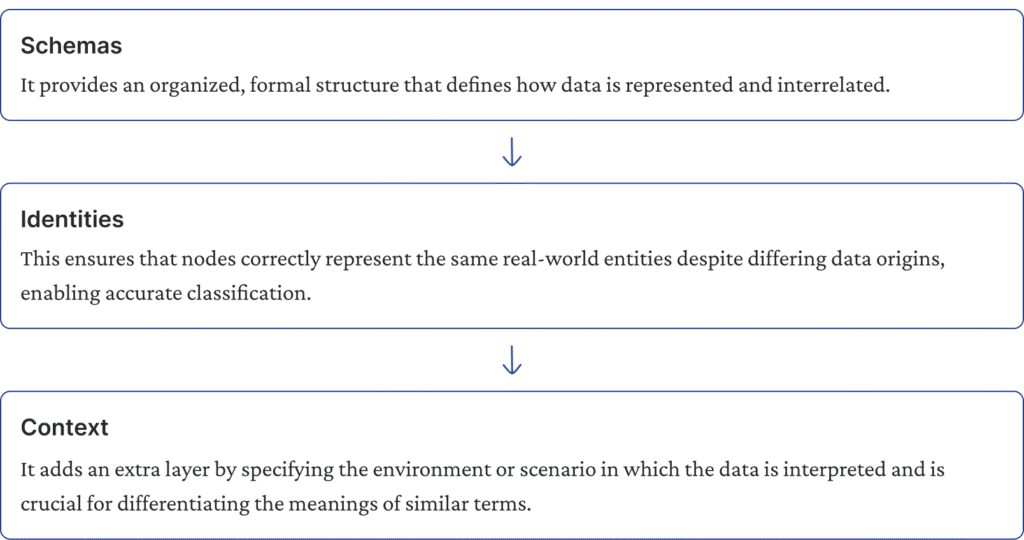
Knowledge graphs integrate datasets from multiple, often structurally diverse sources. This enables applications like search engines or recommendation systems to deliver precise, context-aware results.
The three essential components that make knowledge graphs work include-
Example
Why Are Knowledge Graphs Important For AI?
Knowledge graphs catalyze advanced AI reasoning because they provide a structured, interconnected framework to deliver:
Contextual Intelligence
Unlike traditional machine learning, they enable AI systems to go beyond pattern recognition and move towards genuine understanding and logical inference.
They serve as a symbolic knowledge layer that grounds AI in verifiable facts, making reasoning transparent, traceable, explainable, and more accurate to facilitate:
- Deductive reasoning to infer facts from known and existing information.
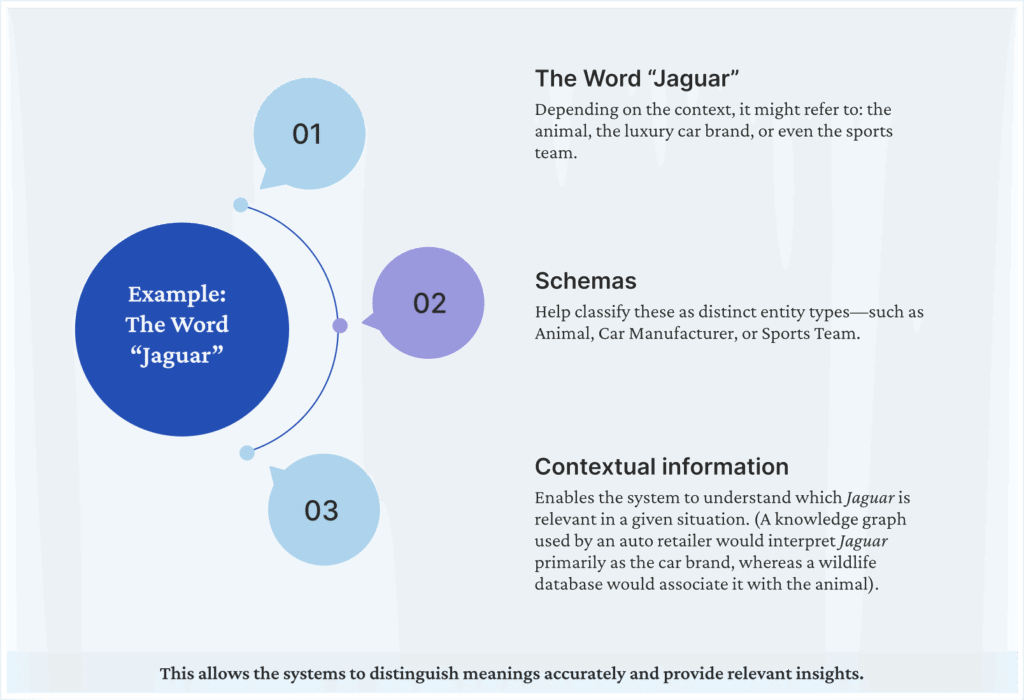
- Disambiguation to resolve semantic issues and help distinguish entities contextually, like Orange the fruit and Orange the color.
- Contextual navigation by helping AI models connect diverse data points meaningfully through logical chains, say, for example, tracing relationships between users, preferences, and products in recommendation systems. This enables multi-hop reasoning across the graph for deeper insights.
- Explainability: by providing clear paths to justify answers, support validation, and improve trust in AI.
Ontology, Knowledge Base, And Knowledge Graphs
Ontology
An ontology in the context of knowledge graphs is a structured set of rules and guidelines that helps organize and describe the types of things (entities) in the graph and how they relate to each other to navigate and use a knowledge graph in a meaningful way.
It acts as a blueprint or map that shows:
- What kinds of things exist
- How they connect
- What combinations are allowed
This helps both humans and machines understand the data better and keeps the information consistent and easy to work with.
Example
A graph about business consultants.
The entities will be:
Consultant: A person who offers business consulting.
Company: A business that might hire consultants.
Industry: The sector a company operates in (like finance or healthcare).
Service: Types of consulting services (like strategy or operations consulting).
Skill: Specific abilities a consultant has (like project management or data analysis).
The ontology will then define how these concepts relate.
Example – XYZ consultant works for a company, has skills, and provides services relevant to an industry.
This structure helps represent real-world facts and relationships clearly in the graph.
So, if you have a consultant named Alice who works for a healthcare company and specializes in strategy consulting and project management, the ontology lets you arrange this information logically and consistently within the knowledge graph. This organized structure then supports complex queries, recommendations, and reasoning about consultants, companies, industries, and services
Knowledge Base vs. Knowledge Graph
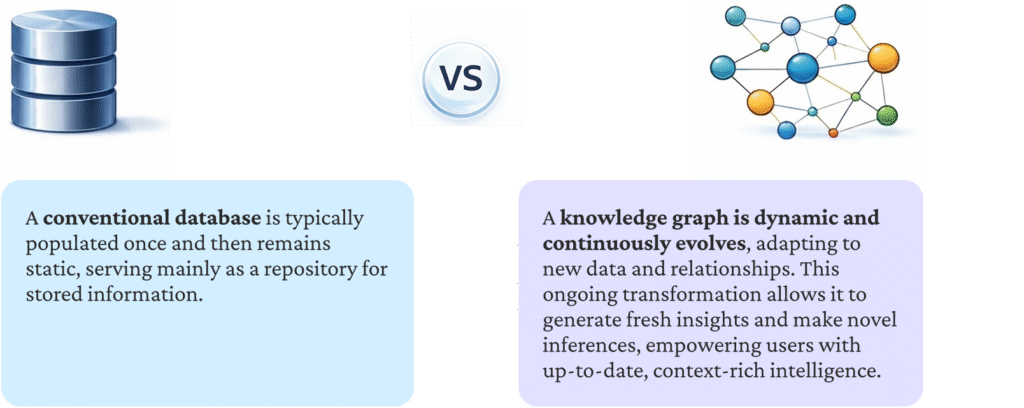
Knowledge Graphs - The Foundation For Advanced AI Reasoning
Knowledge Graphs create a dynamic semantic network by linking every data element—whether people, processes, applications, or assets—allowing AI and humans alike to explore how and why these elements are connected, delivering insights almost instantly.
It provides:
Data Clarity
Effectively addressing data sprawl, it seamlessly links both structured and unstructured data within a single semantic layer, forming a cohesive and easily navigable network.
Sets the Context
Mapping detailed causal relationships within interconnected data, knowledge graphs empower rapid root cause identification, impact anticipation, and precise predictive insights.
Saves Time
Transforming fragmented, siloed data into connected networks, knowledge graphs speed up information discovery and streamline data management. They power faster AI-driven insights, automate entity mapping to cut down manual effort, and enable real-time, intelligent querying across vast datasets.
Delivers Impactful Results
Providing a holistic view of systems, dependencies, and business impact, it enables AI agents and human analysts to make data-driven, strategic decisions across the ecosystem rather than isolated metrics.This allows for smarter outcomes grounded in a comprehensive understanding of interconnected data.
Innovates at Speed
Knowledge graphs connect the dots by integrating past research, experimental results, market needs, and emerging trends into a unified framework that reveals hidden insights and accelerates informed decision-making.
Simplifies Governance and Compliance
Knowledge graphs streamline governance and compliance by connecting data, policies, and users into a unified, transparent system.They replace fragmented systems with a cohesive view, surface risks in real time, and make it easy to assess the impact of policy changes—helping organizations stay compliant without heavy manual oversight.
Knowledge Graphs- A Connected Backbone
The future of Knowledge Graphs promises deeper knowledge representation, federated collaboration, and ethical AI integration.
Embracing these advances can go a long way in harnessing data’s full potential, fueling innovation and enabling smarter, insight-driven decisions.
Articles Referenced
Take A Quantrium Leap Forward With Knowledge Graphs
Quantrium combines deep expertise in advanced knowledge graph architectures, AI-driven data enrichment, real-time contextual analytics, and scalable solutions that transform complex enterprise data into actionable insights—providing your business with a powerful, adaptive, and future-ready intelligence platform.
Connect with us at info@quantrium.ai to connect the dots.