
Retrieval-Augmented Generation (RAG) - Redefining how we interact with information

Summary: Explore Retrieval-Augmented Generation (RAG), an AI technique that combines retrieval and text generation to produce accurate, verifiable, and context-aware responses.
RAG is a hybrid architecture that augments large language models with external knowledge retrieval, to enable –
- Response generation that is grounded in authoritative sources.
- Factual consistency, traceability, and contextual relevance.
It enhances a language model’s reliability by answering queries not just from its training data but by accessing an organization’s current business information, documentation, and knowledge bases relevant to the query.
The RAG Process
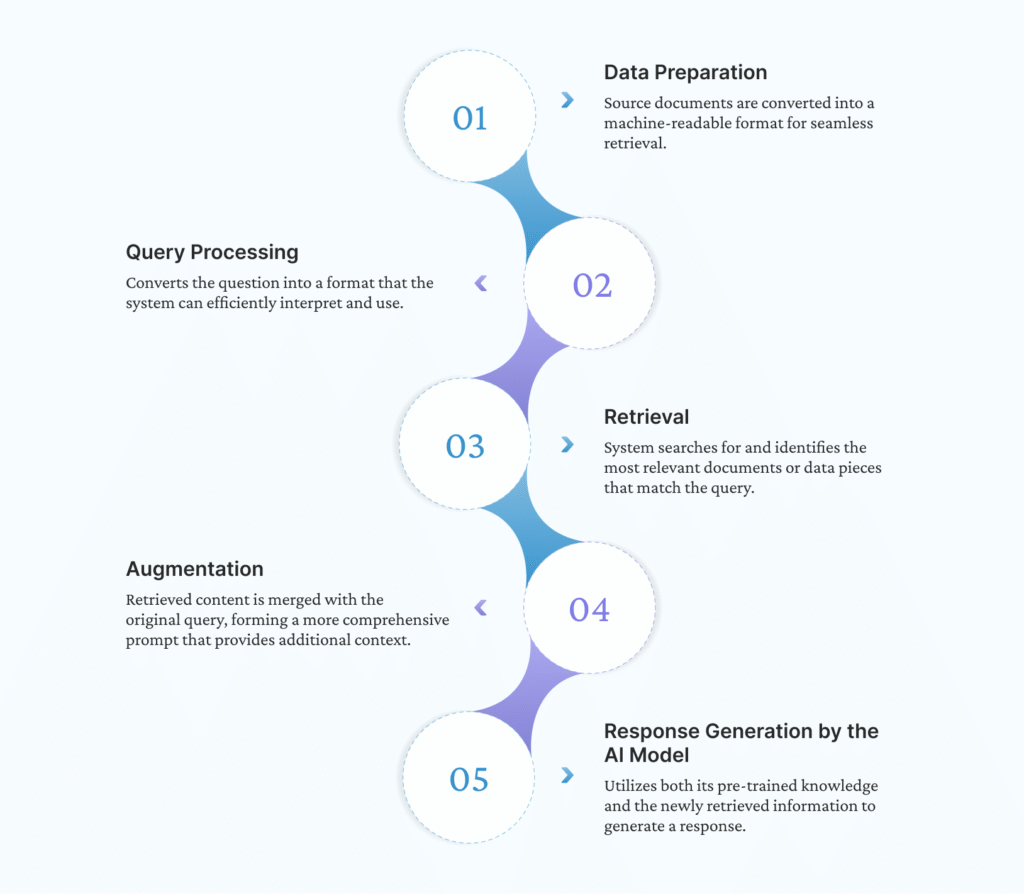
How RAG works
RAG lies at the core of intelligent systems, powered by large language models, and is a gamechanger in delivering precise and contextually relevant answers.

Quantrium Tech
Curated Articles from Quantrium’s Tech Blogs.
Enterprises Don’t Have a Data Problem – They Have an Access Problem
Advantage - RAG
By adopting RAG, LLMs effectively integrate up-to-date data to increase response quality and accuracy. The major benefits of RAG include:
- Enhanced accuracy, relevance, and specialization in LLMs – by making them deeply knowledgeable and context-aware.
- Factual grounding – by integrating fresh, relevant, and specific data into the LLMs to deliver reliable answers.
- Real-time information – to keep responses timely and accurate.
- Resilient LLMs within targeted domains or proprietary knowledge – by conserving both time and computational resources.
- Simplified knowledge base updates – by adding new sources without retraining the entire model.
- Transparency – with clear citations for easy fact-checking.
RAG- Real-World Applications
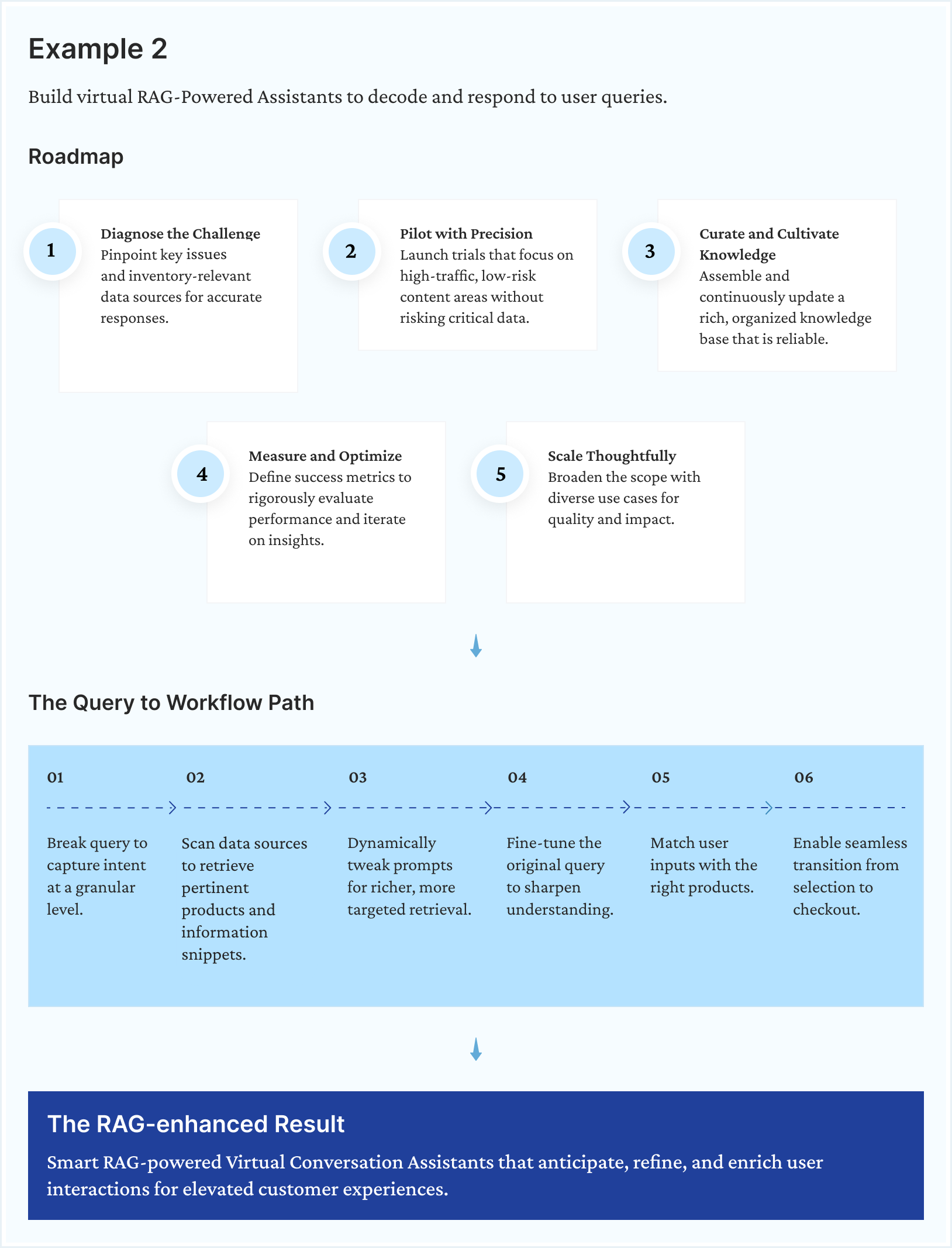
Customer Support
RAG-powered chatbots can:
- Identify customer profiles, subscription records, and usage data, and merge this information with extensive product knowledge repositories to deliver precise, timely, context-aware, and personalized responses.
- Streamline processes by pulling from a pool of approved past translations, style manuals, terminology databases, and relevant contextual materials such as screenshots for enhanced consistency and quality.
Healthcare
Imagine having a medical assistant who can swiftly access and analyze vast amounts of medical data, research, and patient records to provide accurate diagnoses and personalized care.
Smarter Diagnosis
RAG can help doctors make informed decisions by quickly retrieving relevant medical information and generating context-specific insights. This leads to faster and more accurate diagnoses, ensuring the best possible patient care.
Optimized Clinical Trials
By analyzing existing studies and patient outcomes, RAG can streamline clinical trial design, identifying the most suitable patient groups and improving the chances of successful trials.
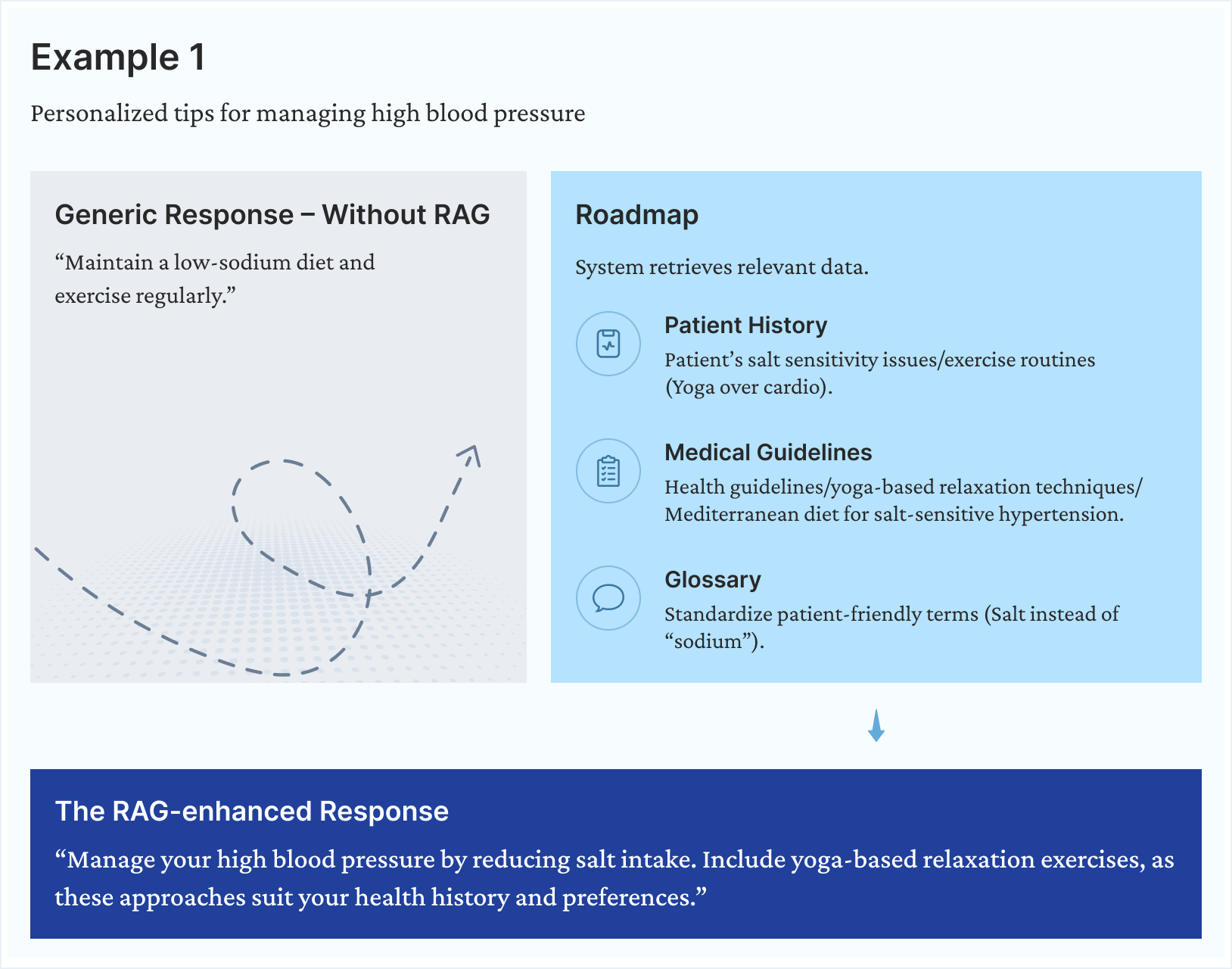
Personalized Patient Care
RAG can create tailored treatment plans, wellness recommendations, and educational materials based on individual patient needs, preferences, and health updates.
Streamlined Healthcare Information
RAG can help healthcare professionals access essential information from clinical guidelines, electronic health records, and medical texts to make informed decisions.
Conversational Healthcare
RAG-powered chatbots can engage patients in seamless conversations, providing relevant information on symptoms, treatment options, preventive measures, and healthcare-related concerns.
Summarized Medical Literature
RAG automatically condenses large volumes of medical literature, clinical guidelines, and research articles into concise summaries, saving time and energy for healthcare professionals.
Code Generation for Developers
A gamechanger for code generation, RAG helps developers generate accurate and efficient code with minimal effort.
Retrieving Relevant Code Snippets
The RAG model retrieves relevant code snippets from existing repositories to adapt and extend them to meet specific project requirements, reducing the risk of errors and bugs.
Code Generation and Documentation
RAG-powered code generation models can:
- Fetch relevant information from existing code repositories
- Develop accurate code and documentation
- Fix code errors and bugs
- Convert natural language descriptions into code implications
- Predict the next code block
- Generate natural language descriptions from code
- Create and execute new code for comprehensive analysis
Streamlined Sales Automation
Filling out Request For Proposals (RFPs) and Request For Information (RFI) can be a tedious and time-consuming task in the B2B sales process. RAG can help in:
- Automatically populating RFPs and RFIs.
- Retrieving relevant product details, pricing, and past responses to fill out forms accurately and efficiently.
E-Commerce
RAG can help e-commerce businesses create personalized experiences for their customers by analyzing customer data and market trends.
Financial Forecasting
RAG-powered forecasting and analysis combine real-time market data, financial reports, and economic indicators to provide accurate insights, enabling investors to make informed decisions and stay ahead in the market. This integration of data sources enables more precise predictions and improved investment outcomes.

Quantrium Flux
Your front-row seat to the ever-evolving world of technology.
In all its depth and diversity.
Can Gen AI make movies faster and cheaper?
Challenges and Limitations of Retrieval-Augmented Generation (RAG)
Despite its many advantages, implementing RAG comes with multiple challenges:
- The quality of data –the accuracy of the underlying knowledge base.
- The relevance of prompts used to retrieve data.
- Incorrect information generation – due to the presence of incomplete or ambiguous content retrieved.
- Debugging issues – due to complex pipelines that demand traceability and detailed analysis to identify and fix issues.
Collectively, these can lead to high latency, due to the multiple stages involved -embedding, vector search, and re-ranking that often result in slow performance, especially without proper caching and optimization.
When to Choose Retrieval-Augmented Generation (RAG)
RAG stands out as an attractive option if constraints, such as limited time or budget, make fine-tuning less feasible.
RAG is a strong choice for AI systems that require:
- Up-to-date knowledge: Ideal for applications with frequently changing information, such as market trends, legal precedents, or customer-specific data.
- Transparency and source attribution: Provides verifiable, source-backed responses, building trust and confidence in AI.
- Resource efficiency: Offers a sustainable and cost-effective way to incorporate new or private information without constant model updates.
- Dynamic data sources: Allows for flexibility in knowledge sources, enabling easy updates or swaps without retraining the entire LLM.
- Sensitive or private data: Enhances security and data sovereignty by providing access to sensitive information without feeding it into the LLM’s training data.
Articles Referenced
Take a Quantrium Leap
Stay ahead and informed with the latest insights and strategies to navigate the evolving AI landscape.
Sign Up for our Newsletter
Would love your feedback and suggestions for improvement.
Write to us at  info@quantrium.ai
Disclaimer
This document is produced by Quantrium as general guidance and is not intended to provide specific advice. If you require consultancy/ advice/implementation or further details on any matters referred to, please contact us at info@quantrium.ai
References
Third-party information or references are for descriptive purposes only and have been acknowledged duly and do not represent/imply the existence of any association between us.