
GEO is the new SEO
Winning in the Age of Generative Search
Newsletter Edition #11 | September 2026 | Read Time: 8 min

Summary
By 2026, traditional search engine volume will drop by 25%, with search marketing losing market share to AI chatbots and other virtual agents…”.
Gartner
Long Live the Prompt
For decades, enterprises built their online presence around a single north star:
search engine rankings. And ranking on page one of Google meant earning a link in a list.
That calculus is rapidly shifting now.
Something fundamental has changed in how people find information.
And it has happened in the blink of an eye and is still accelerating.
Users who once typed two keywords into a Search Bar and scrolled through ten blue links now open generative AI platforms (ChatGPT, Perplexity, or Claude) to ask a full question in plain English and get their answers.
And if your company’s name isn’t appearing in that AI’s response, you are probably
missing important customer conversations.
The question is no longer about where you rank; it’s whether you’re part of the answer.
So, how do you get in?
From Search Results to AI Answers
- The Rise of Generative Engine
Optimization (GEO)
Definition: GEO is the “practice of optimizing your presence and content to appear in responses – generated by AI-powered search systems – delivered by platforms like ChatGPT, Claude, Perplexity, Google, and others.”
So, when a user queries an AI-powered search system, the engine doesn’t return a directory of links and leave the rest to the reader.
It ingests, evaluates, and synthesizes content from across the web and then delivers a single, coherent response that is authoritative, clearly attributed, factually precise, and optimized for information integration directly.
It may also include a direct recommendation, a comparative breakdown, and contextual follow-ups, all without the user ever having to click through to a source.
Example
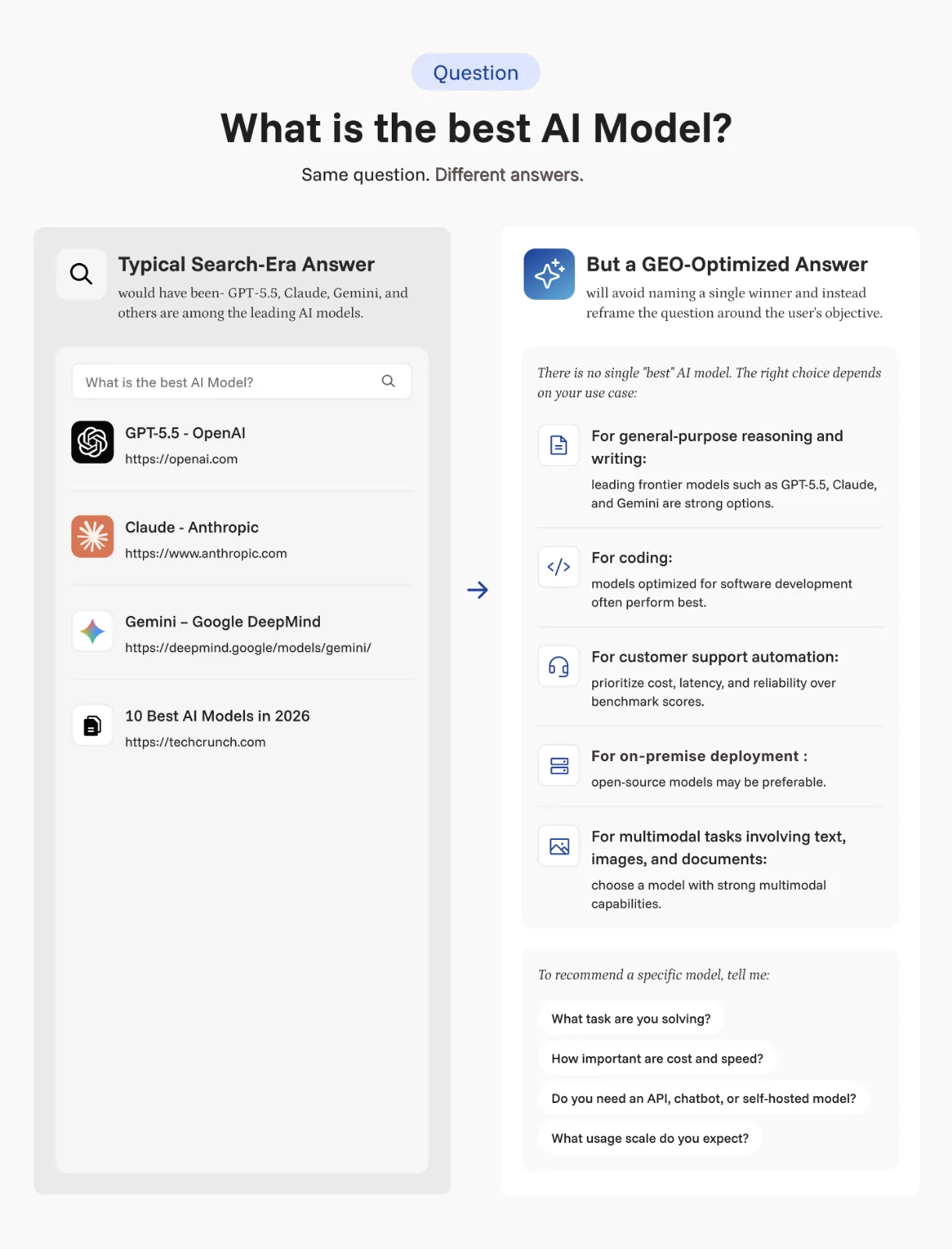
Inference
1. Search Engine Optimization (SEO)-Tries to rank for “the best AI model”.
Generative Engine Optimization (GEO) – Tries to become the source that helps the AI address the user’s underlying intent by providing context, comparisons, decision criteria, and follow-up questions.
2. A GEO-focused company would therefore rewrite the query and title it as follows:
Which AI model is best for coding, customer support, content creation, research, and enterprise deployments in 2026?
Rather than: The Best AI Model in 2026.
3. The Core Distinction: Clicked vs. Cited
SEO gets you clicked. GEO gets you quoted.
Traditional search returns a list of links and lets users decide which to visit.
Generative search synthesizes information from multiple sources into a single, authoritative conversational response — and attributes that response to a small handful of sources.
The GEO Playbook
When a user asks a question, the AI systems don’t just answer from what they memorized during training. Instead, they perform a live retrieval process, working through several steps:
Breaking down the query: turning the user’s question into a searchable form.
Searching knowledge sources: pulling documents from a database, the web, or
internal files.
Evaluating relevance and authority: ranking those documents by how trustworthy and on-topic they are.
Synthesizing a response: writing an answer grounded in that material.
Attributing sources: citing which documents the answer relied on.
This approach is called Retrieval-Augmented Generation (RAG).
A more advanced version, Agentic RAG, takes this further by embedding
autonomous AI agents into the retrieval process itself.
Rather than retrieving once and stopping, these agents can:
- Reflect on whether the retrieved information is actually sufficient.
- Plan a multi-step search strategy.
- Use tools to query different sources.
- Collaborate across multiple agents handling different sub-questions.
This lets the system loop back, refine its searches, and gather better context before producing a final answer.
The implication is significant: retrieval is not a single event. It is a multi-stage investigation.
The Three Types of AI Visitors on Your Website
The retrieval process shows up on the site as three distinct types of visitors.
- LLM crawlers that build training data.
- RAG scrapers that fetch data in real time to supplement live user prompts (used in enterprise chatbots, shopping assistants, and customer support tools).
- Agentic browsers – semi-autonomous systems like AutoGPT or Perplexity that explore, compare, and extract content to perform specific tasks like comparison shopping or data aggregation on behalf of a human prompt.
Tactics to drive AI visibility
Knowing how the content is sourced is only valuable if you act on it.
Answer-Shaped Content
Generative engines favour content structured as a response to a likely user question. This means:
- Placing clear definitions and direct answers at the top of pages.
- Using descriptive headings that map to natural questions.
- Applying simple sentence structures that AI systems can parse cleanly.
- Organising supporting detail in scannable formats: numbered lists, comparison tables, and labelled sections.
Structured Data and Schema Markup
GEO treats every page like an API response that needs to be parsed, vectorized, and cited by large language models.
It requires implementation of structured data payloads: the equivalent of type safety for content, which enables AI parsers to identify headline, author, publish date, and topic without inference.
Statistics and Expert Quotes
Statistics make content up to 33.9% more visible in AI responses, because AI systems cannot generate original data and gravitate toward sources that provide it.
Expert quotes boost AI visibility by up to 32%, citations to authoritative sources add 30.3% more visibility, and clear, fluent writing improves citation rates by up to 30%.
(Source: Princeton Research)
Authority across the Web’s Trust Network
AI models build foundational knowledge from training data that includes not just academic papers and Wikipedia, but also forum discussions on platforms like Reddit and Stack Overflow. Brands can position themselves for future training runs by establishing presence in community platforms, authoritative sources, and registered directories.
Third-Party Citations -Not Just Backlinks
AI engines strongly favour earned media: authoritative third-party sources over
brand-owned content. This dynamic is now the foundation of any effective GEO strategy.
A company’s own blog, however well-written, is treated with more scepticism than a mention in an industry report or a journalist’s analysis. PR, analyst relations, and thought leadership in external publications form an effective AI visibility strategy.
Fresh Content
Brands need to refresh content regularly: updating data, adding new insights, and maintaining a visible timestamp to enable easy detection by AI parsers.
Core GEO metrics every brand needs to track
AI Citation Frequency
How often does your brand appear in AI-generated answers across ChatGPT, Perplexity, Gemini, and Google AI Overviews?
Share of Voice in AI
Your brand’s mentions relative to competitors across AI platforms.
Share of Answer
When your brand appears in an AI response, what percentage of that answer draws from your content?
Accuracy and Sentiment
Is AI-generated content about your brand factually correct? Does it portray your brand positively?
AI-Referred Traffic
Are visitors arriving from ChatGPT or Perplexity? Now trackable via server logs (crawlers, agent traffic, etc.) and emerging analytics platforms.
Social Listening
AI engines do not learn about your brand only from your website.
They learn from the entire web:
- Conversations happening about you on social platforms, in forums, in news articles, in review sites, and in community discussions.
- Social monitoring that helps marketers identify and activate the high-impact conversations and shape algorithmic brand understanding.
The Final Step- Turning Signals into Structure
Understanding what is being said is the first step.
The second step is transforming that intelligence into structured, AI-ready content and data signals.
GEO demands ongoing audits, competitor intelligence, citation analytics, and content optimization, not as separate activities but as continuous, integrated workflows. Platforms that bring all of this into one dashboard make it practical to manage the entire GEO cycle in one place instead of stitching together multiple tools.
GEO is about staying AI-visible in real time
GEO is not a one-time audit or a content sprint. It demands the same ongoing discipline as SEO, applied to a new set of channels, signals, and machines.
The brands that win will be those with the intelligence infrastructure to know what AI is hearing about them, act on that continuously, and structure their data so that AI agents find them, trust them, and cite them.
Get Found Before You Get Replaced
Every day, over one billion prompts are sent out, and generative AI-powered search is fast emerging as a go-to tool to access information.
The brands building GEO infrastructure today – investing in social listening to understand how AI perceives them, in data analytics to structure that intelligence, and in content that machines can find, parse, and trust — are building the digital authority that will define market leadership in the generative search era.
The question is no longer whether to optimize for AI. The question is whether you will do it before your competitors do.
The window to act is now!
Quantrium offers Social Media Listening and Data Analytics Services to understand how your brand is being discussed, identify emerging trends, and uncover the insights needed to strengthen your visibility across AI-driven search and discovery.
Book a Discovery Call. Reach us at info@quantrium.ai
Articles Referenced
The Difference Between SEO & GEO Wins: What Ranks Versus What’s Cited
Geoptie — GEO Tools & AI Search Optimization Platform
https://www.techmagnate.com/blog/seo-to-geo-roadmap-ai-search-visibility/
https://dev.to/elenarevicheva/geo-vs-seo-why-chatgpt-citations-matter-more-than-google-rankings-2026-05-18-4o37