
AI-Native Firms
The Next Competitive Frontier
Newsletter Edition #09 | July 2026 | Read Time: 8 min

Summary
If you’ve used ChatGPT or any form of generative AI, you’ve already experienced an AI-native system where AI drives interaction, decision-making, and value creation at the core.
In AI-native companies, problem-solving begins with intelligent capabilities.
Products, workflows, and experiences are reimagined around intelligence from the ground up, redefining how businesses operate, scale, and innovate.
AI-native isn’t about adding intelligence to what exists. It’s about building what didn’t exist before.
Call it a new foundational standard for modern enterprises: it marks a paradigm shift in how technology is designed, built, and delivered.
AI-native isn’t a change or disruption. It is a structural reset.
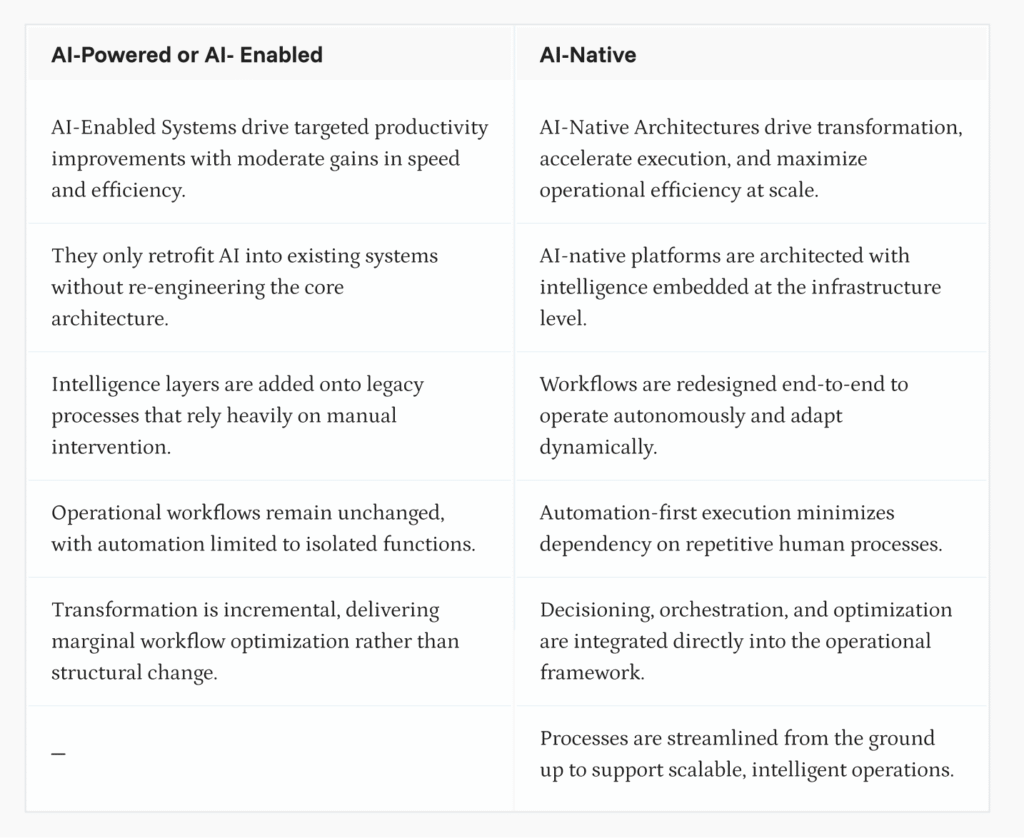
AI-enabled systems add intelligence to an existing framework.
Whereas AI-native systems are engineered around AI from the outset, influencing architecture, data strategy, decision-making, user experience, and scale.
AI-native isn't a feature set - it's a foundation. Architecture is the strategy.
Building—or evolving into—an AI-native enterprise demands a clear focus on foundational pillars that collectively define its architecture and long-term advantage.
Data as Core Infrastructure
In AI-led enterprises, data isn’t an input; it’s the operating substrate.
All intelligent systems rely on a steady stream of both structured and unstructured data, processed and distilled into signals clear enough to drive sound decisions. The advantage lies not in volume alone, but in how effectively data is captured, standardized, and activated across the workflows to make it a strategic asset. When this foundation is engineered with precision, AI becomes an enterprise-wide force multiplier.
Trust Architecture: Security and Privacy by Design
AI systems run on some of the most sensitive and high-value data an enterprise holds. Resilient enterprises embed governance directly into their data and model pipelines, ensuring access control, traceability, and regulatory alignment at every layer.
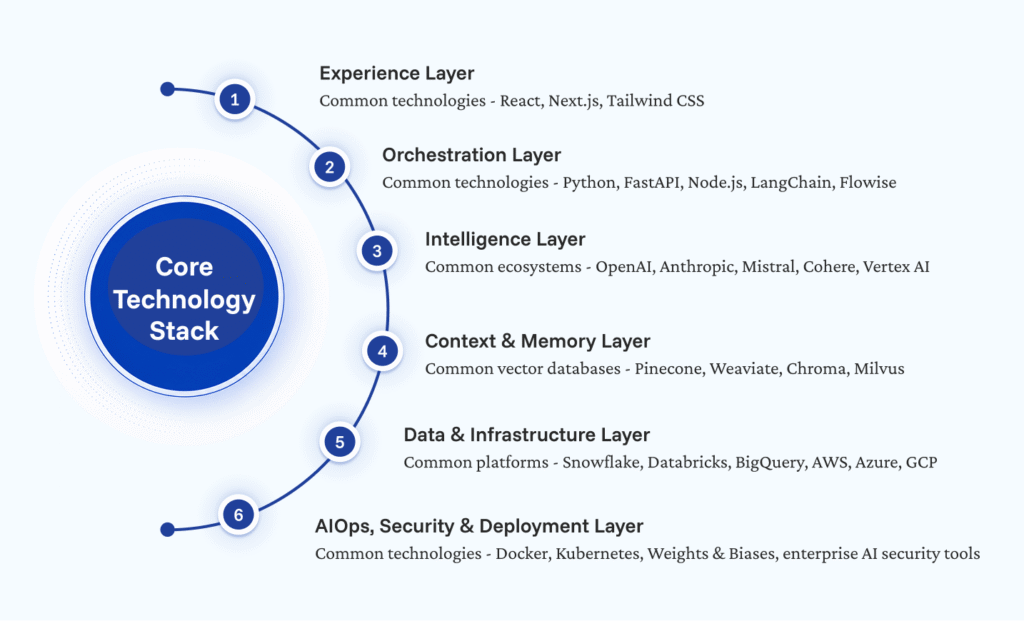
The Intelligence Stack
Behind every AI-native enterprise is a tightly integrated stack that converts data into action. Early-stage adoption often builds on existing frameworks, but long-term differentiation emerges from systems tailored to proprietary data and business context. Over time, the stack evolves from experimentation to a deeply embedded capability, one that continuously informs decisions, automates complexity, and sharpens competitive edge.
Agentic Workflows
AI-Native enterprises leverage GenAI-powered agents that can independently execute complex, multi-step tasks: from legal document review and intelligent content creation to personalized customer interactions and decision support.
Continuous Assurance Systems
AI performance is not static. As environments shift, models can drift, degrade, or produce unintended outcomes. Sustained accuracy and effectiveness depend on mechanisms that enforce discipline across the lifecycle.
Guardrails establish clear limits early in the development lifecycle to promote ethical model design and deployment.
Safeguards provide ongoing runtime oversight, activating notifications or expert intervention for deviant responses.
Iterative feedback loops feed new data back into the system, enabling continuous recalibration.
AI governance establishes the guardrails for secure and responsible AI adoption.
Access controls determine the data, systems, and capabilities available to each AI agent.
And validation frameworks assess model performance, consistency, and adherence to business policies.
Collectively, these elements foster reliable, ethical, and trustworthy AI operations.
Explore our Deep Dive Archive

Model Context Protocol (MCP) The Universal Standard for AI System Connectivity
MCP enables AI applications to connect external systems seamlessly and efficiently.

Knowledge Graphs- The Hidden Map Behind Everything You Search, See, and Know.
Knowledge graphs transform corporate data into AI-ready contextual intelligence effortlessly.

Small Language Models – Think Big. Act Small.
Small Language Models deliver powerful AI through efficient, lightweight intelligence.
The Operating Stack of AI-Native Enterprises
Ultimately, AI-native is not a technology label. It is an operating philosophy centered on redesigning the enterprise around intelligent systems. AI-native enterprises are built on a layered AI stack that reshapes how work is executed, decisions are made, and value is created.
Embedded AI across workflows
The first layer consists of AI capabilities embedded directly into enterprise applications and vendor platforms. These systems enhance core business functions by accelerating execution and improving consistency. This is usually the starting point -integrating intelligence into existing workflows without redesigning the operating model itself.
Agentic Systems that execute work
The second layer introduces agentic AI systems that autonomously execute multi-step workflows with minimal human involvement. These systems coordinate actions across applications, route information between environments, and automate routine decision-making in real time. Executional in nature, they reduce operational friction and compress execution cycles across functions.
Proprietary AI as competitive infrastructure
The third layer is an internally developed AI infrastructure built around proprietary data, workflows, and institutional knowledge. Some enterprises extend existing platforms, while others develop standalone systems tailored to their operating environment.
A long-term differentiator, it shifts the competitive advantage from access to AI tools towards ownership of AI-native processes and intelligence models unique to the business operations.
The AI-Native workforce
In AI-native enterprises, value creation is defined by the effective use, refinement, and scaling of intelligent systems. High-value talent combines domain expertise with a practical understanding of system behavior, limitations, and risk, and the quality and scalability of the systems created to measure performance.
Human –in-the-loop
AI-native enterprises operate on a fundamental principle: if a task does not require human judgment, it should not depend on human execution.
This principle reshapes investment priorities, operating structures, and workflow design. Core operations are designed around what AI can execute reliably at scale. Human involvement is reserved for areas requiring accountability, contextual reasoning, ethical oversight, or strategic decision-making.
AI-Native vs. Embedded AI
AI-native systems are built with AI at their core, enabling faster adaptation, continuous learning, scalable automation, and the creation of entirely new operating models and digital experiences.
Embedded AI enhances existing technology stacks by adding AI-driven capabilities such as intelligent components, APIs, workflow automation, and legacy system optimization, improving efficiency without rebuilding the entire infrastructure.
AI-Powered or AI- Enabled x AI-Native
Not Every Enterprise Is Built for AI-Native -Here's Why
For all the momentum behind AI-native strategies, most organizations remain structurally unprepared for what it truly demands.
The Unit Economics Trap
One LLM call is affordable. Chain thirty of them into an agentic workflow, feed each one a large context window, and run that sequence thousands of times a day: and the economics look nothing like the demo. Each link adds latency and cost.
The ROI Blind Spot
Few organizations have rigorous visibility into their cost-per-task or cost-per-user, especially as usage grows. Without this metric, companies risk scaling a product whose unit economics quietly falls apart. Every additional user or task is a net loss rather than a source of margin.
The Data –Readiness Check
Feeding an AI system inconsistent, incomplete, or biased data guarantees unreliable output, regardless of how sophisticated the model is. Data quality is a prerequisite for trustworthy AI-driven decisions.
The Adoption Gap
Without effective change management, even the best technology struggles to deliver value.
The Foundation-First Trap
Some teams invest heavily in AI infrastructure before identifying concrete use cases. This “build it and they will come” approach often results in rigid, over-engineered platforms that don’t map well to actual business needs, wasting time and capital with little to show for it.
Legacy Constraints
True AI-native transformation requires more than layering AI onto existing systems. If an enterprise’s infrastructure, latency tolerances, and energy/compute assumptions are still designed for a pre-AI world, it will structurally limit what the organization can actually achieve with AI.
Is Your Enterprise Ready to Go AI-Native?
Assess before you Act
How mature are your current AI capabilities, and where are the operational gaps limiting scale?
Do you have a clearly defined AI strategy aligned to business priorities and measurable outcomes?
Are your teams equipped with the right AI, data, and engineering capabilities to drive adoption?
Is your enterprise building a culture where decisions are driven by data, not intuition?
Can your existing infrastructure support the compute, security, and scalability demands of AI workloads?
Which high-impact AI use cases can be piloted quickly to validate value and accelerate momentum?
How will you measure the performance, ROI, and business impact of AI initiatives over time?
Is your enterprise prepared to continuously iterate, optimize, and evolve alongside rapidly advancing AI technologies?
Are AI investments being treated as isolated experiments or as foundational business transformation initiatives?
Can the operating model enable AI to move from innovation labs into enterprise-wide execution?
AI-Native: The Path Forward
Building an AI-native enterprise is an ongoing transformation that demands sustained investment in innovation, adaptability, and organizational learning. Success depends not only on adopting AI technologies, but on creating the right foundation to scale them effectively across operations.
Enterprises must begin by understanding their current AI maturity, defining a clear strategic roadmap, and strengthening internal AI and data capabilities.
Equally critical is the ability to foster a data-centric culture, modernize infrastructure to support AI workloads, and identify high-impact use cases that can demonstrate measurable value early.
The most resilient AI-native companies don’t chase total automation. They master the art of selective deployment: automating ruthlessly where it scales, supervising tightly where it risks, and reserving humans for judgment calls that machines can’t touch. Speed will define them, but so will ironclad controls—leveraging AI for exponential efficiency while anchoring on human insight.
And this blueprint redefines an enterprise: leaner teams, hyper-agile operations, and AI-fueled intelligence at every layer.
Purpose, tough choices, trust, and accountability? Those remain indelibly human.
Articles Referenced
https://www.forbes.com/sites/alexanderpuutio/article/what-are-ai-native-organizations-and-how-to-build-one/
https://online.hbs.edu/blog/post/ai-native
https://www.ctoforum.org/wp-content/uploads/2025/07/VideaHealth-Building-the-AI-Factory-TMS.pdf
https://blog.smsit.ai/2025/11/06/the-rise-of-ai-native-companies-and-how-to-join-them/